
She Stayed. He Left to Fight for Them. And Then She Built Something That Brought Him Back.
She Stayed. He Left to Fight for Them. And Then She Built Something That Brought Him Back.
Rabecca Ajah Joh arrived in Uganda with her husband, her children, and nothing else. The war had taken everything. Then the weight of providing for a family in a foreign land sent her husband back across the border to try his luck from the other side. What Rabecca did while she waited is the kind of story that makes you believe in the human spirit all over again.
Her husband told her he was going back to South Sudan.
Not to abandon her. Not to walk away from his children. But because sitting in a refugee settlement watching his family go hungry was something he could not carry anymore. He was a man who had always found a way. He believed, or needed to believe, that back on his own soil he could find a way again. That he would make something work in South Sudan and send for them, or send money, or find a road that this place was not giving him.
Rabecca understood. And she let him go.
Then she turned back to her children, to the shelter, to the empty pot. And she asked herself the only question that mattered now.
What are you going to do?
The Crossing That Cost Everything
When Rabecca and her family fled South Sudan, they carried what every refugee carries. The bare fact of being alive, and not much else. The journey to Uganda was long and brutal, the kind of journey that takes something from you that you never fully get back. But they made it. They arrived in the settlement in Adjumani District. They were together. That, she told herself, was enough.
It was not enough.
The life they had known, the life that made sense to them and gave them dignity and direction, did not survive the crossing. Back home, her husband had been a provider. A man who knew his role and filled it. Here, in this unfamiliar place, with no cattle, no land of their own, and food rations that shrank a little more with each distribution, he was something he had never been before.
He was helpless. And helplessness, for a man who had spent his whole life providing, is a very particular kind of suffering.
“He used to sit outside for a long time without saying anything,” Rabecca says quietly. “I could see it was eating him. A man who cannot feed his children, that pain is very deep.”
She watched it happen slowly, the way a fire goes out. First the silence. Then the distance. Then the decision. He could not sit still and do nothing. He would go back. He would try from there. He would find a way to provide from the only place in the world where he still knew who he was.
He left for South Sudan.
And Rabecca stood in the doorway of their shelter with her children around her, carrying both his absence and her own fear, and she decided that falling apart was not something she had time for.
“A man who cannot feed his children, that pain is very deep. I could see it was eating him from inside. So he went back to try. And I stayed. And I tried too.”
A Hoe She Had Never Held Before
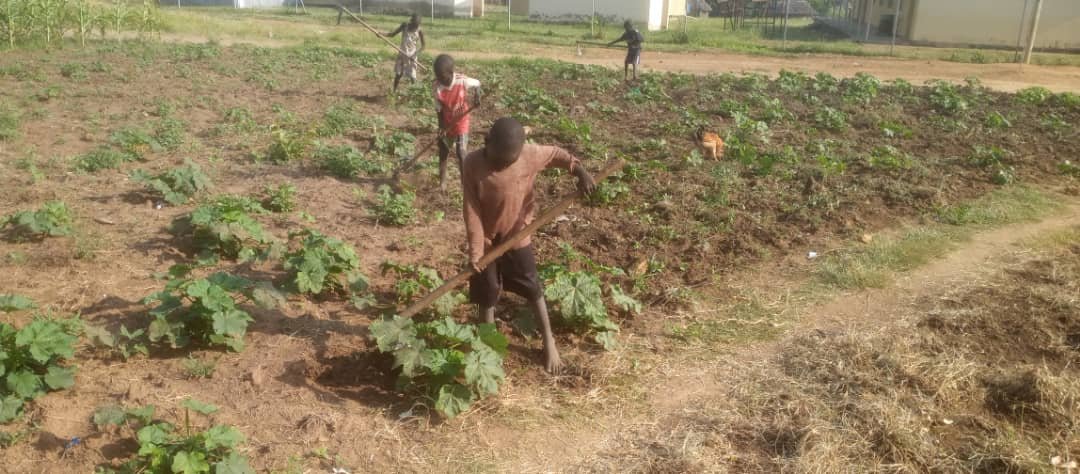
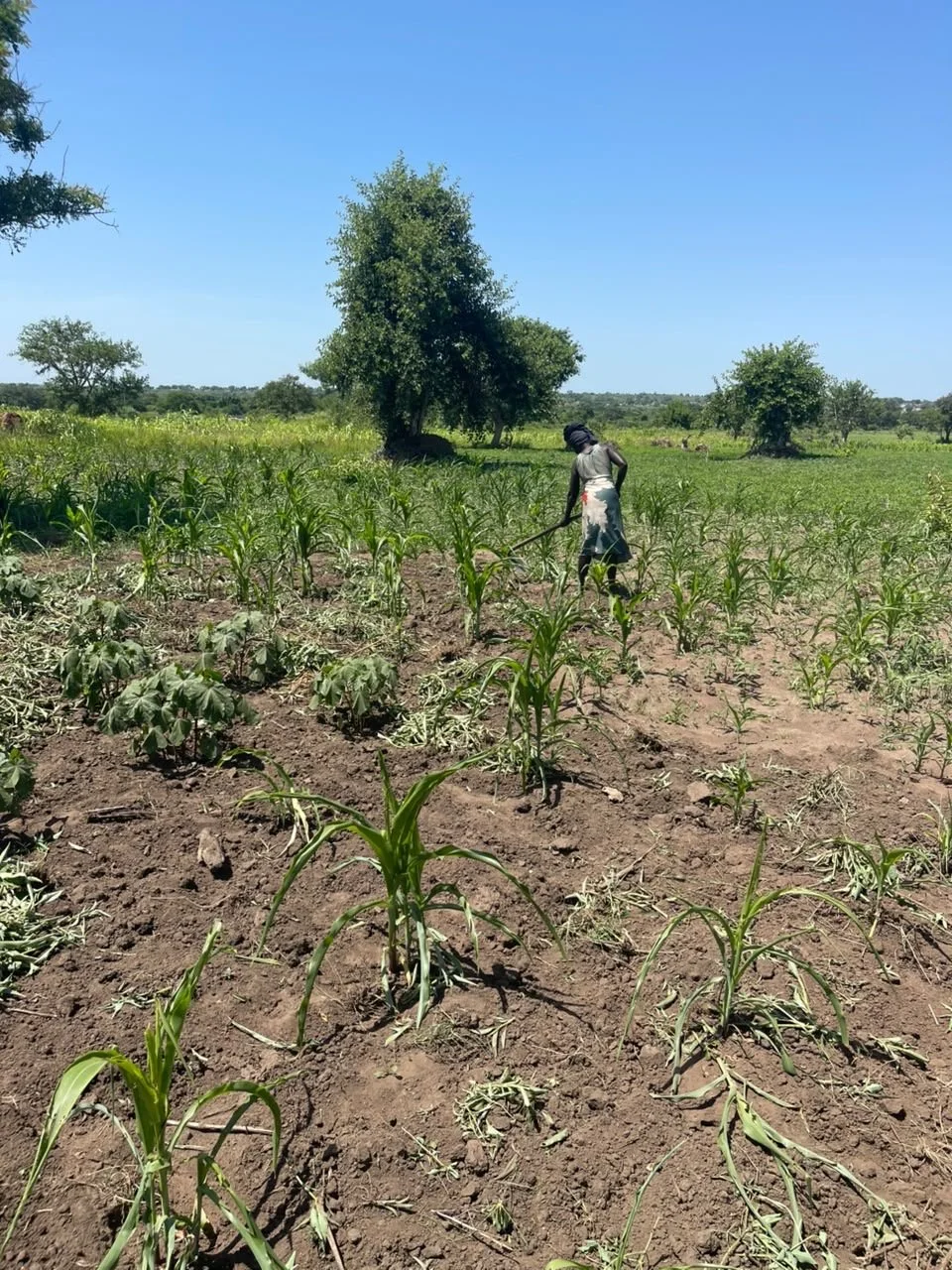
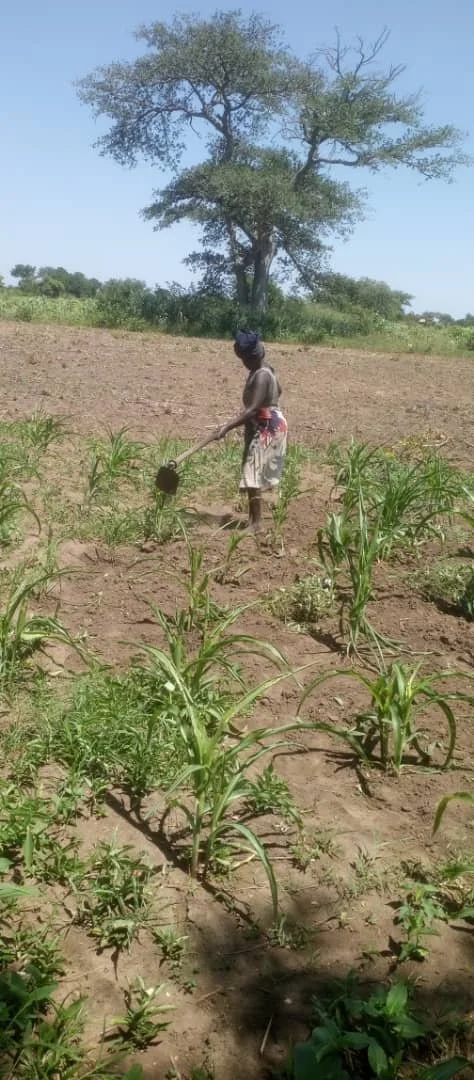
SSLCD came into her life at the moment she needed it most. Not with pity. Not with speeches. But with something practical and real. They hired agricultural land on her behalf. They gave her seeds. They sent people who sat beside her in the soil and showed her, with patient hands, what she had never been taught.
Rabecca had not come from a farming family. The hoe was not a tool she had grown up with. The first weeks were hard in a way that was different from hunger. Hard in the way that learning is hard when your hands are slow and your back aches and you are not sure the thing you are working toward is real.
But she kept going. Because the children were watching. Because there was no one else. Because somewhere across a dangerous border her husband was trying too, in his own way, and she was not going to be the one who gave up.
“I talked to the ground,” she says, and laughs a little at herself. “I said to it: you are all I have right now. Please work with me.”
The ground worked with her.
The Harvest That Changed the Story
Her first harvest changed the air in the compound. There was food. Real food, food she had grown herself, food that did not depend on a distribution schedule or a donor’s decision somewhere far away. Her children ate. The pot was full. She sat with that feeling for a long time and let it become something solid inside her.
Then she did it again. And again.
Season by season, Rabecca Ajah Joh built something in that foreign soil. She expanded to a second plot. She grew more than her family could eat and sold the surplus at the market. She managed her earnings carefully, the way a woman manages when she knows there is no safety net below her.
And then one day, she did something that stopped people in the settlement cold.
She bought a cow.
Then another one.
“When people saw those cows,” she says, and her eyes go bright with the memory, “they could not believe it. A woman alone. A refugee. Two cows. They asked me: Rabecca, how? I told them: the land told me how.”
“A woman alone. A refugee. Two cows. They asked me: Rabecca, how? I told them: the land told me how.”
She Called Her Husband
South Sudan had not been kind to him either. The road he had hoped to find there did not open up the way he had prayed it would. He had tried. He had struggled. And slowly the truth had settled over him that the life he was looking for was not behind him in his homeland.
It was wherever his family was.
When Rabecca called him and told him what had happened, the farms, the harvests, the cows, the two plots of land she now managed on her own, something shifted in him. She was not calling to shame him. She was calling to tell him there was a way. That SSLCD was still there, still helping, still willing to walk beside anyone who was ready to try. She was calling to tell him that the soil he had dismissed as foreign was the same soil that had fed his children through every season he was gone.
She told him to come home.
He came.
He arrived back in Adjumani the way people arrive when life has finished teaching them something difficult. Quietly, without fanfare, ready in a way he had not been before. Rabecca did not make it harder than it needed to be. She showed him the fields. She put a hoe in his hands. She introduced him to the SSLCD team who had sat with her in the dirt and taught her everything she now knew.
And now, side by side in the same soil that once felt foreign and impossible to them both, they are learning together.
“He is still new at it,” Rabecca says with a smile that contains everything. The long months alone. The relief of his return. The quiet pride of a woman who held the whole thing together when it could have easily fallen apart. “But he is learning. And that is enough for now.”
“He went back to try for us. I stayed and tried for us. In the end, the trying brought us back together.”
What the War Could Not Take
She lost everything the war could take. Her country. Her certainty. For many months, even her husband.
But Rabecca Ajah Joh did not lose herself.
She found something instead. In the dirt, in the discipline of seasons, in the stubborn daily act of planting something and trusting it will grow. She found that she was stronger than the war had counted on. That her hands could do more than she had ever been asked to prove. That a woman who refuses to stop moving can, in time, move everyone around her.
Even a husband who had crossed back into a war zone looking for a different answer.
“He is back,” she says simply. “We are together. We have land. We have cows. We have a future.”
She pauses. Looks at her hands. Looks up.
“I did not think I would say that sentence again. But here I am. Saying it.”
Rabecca’s story is still being written, one season and one harvest at a time. And now her husband is writing his own chapter alongside her, learning what his wife already knows: that this soil, given time and care and the right support, can become home.
SSLCD walks beside families like hers every day in the settlements of Northern Uganda.
Not in front of them. Not behind them. Beside them.
You can be beside her too.
Donate at hopeforsouthsudan.com
Every seed planted is a family finding its way back to each other.
